Purpose, region, organisational role, intended users and affected people, sector, data use and decision impacts inform applicability.
THE PLATFORM / AI DELIVERY IN PRACTICE
Your AI-assisted work.
Validated through delivery.
Validate requirements, designs, code and QA artefacts your teams create with AI. Follow the assessment from project context to findings backed by the material examined, human review and reassessment.
One module, several, or all four. Your assessment keeps its scope visible.
THE ASSESSMENT PATHHUMAN REVIEW RETAINED
01Project contextDeclared facts + artefact signals
02Applicable obligationsConfigured coverage · references
WHAT THE FINDINGS SHOWFindings, gaps & uncertainty
Inspect the basisA person reviews the result.Record a decision. Address gaps. Reassess.
FOUR PHASES. ONE ASSESSMENT-LED APPROACH.
Different questions.
The same need for proof.
Choose a phase to inspect its material, assessment focus and output. The example below reuses selected findings from the recorded fictional EU/UK recruitment project; saved phase results keep the material and recorded decision together.
REQUIREMENTS / PHASE CHECK
What needs to be defined?
EXAMINE
Stories and requirements.
REVIEW
Duty gaps, conflicts and suggested acceptance criteria or test scenarios.
RECORDED FICTIONAL RECRUITMENT PROJECT / EU + UKSELECTED FINDINGS
APPLICABLE CONFIGURED OBLIGATION
A route to request human intervention and challenge an automated work decision.
MATERIAL EXAMINEDRecorded requirement
“Automatically reject applicants below score 60 with no human review.”
WHAT DUTAIX IDENTIFIED
The requirement excludes human review.
The recorded assessment flagged a conflict with the relevant automated-decision safeguards.
Basis: recorded requirement · EU GDPR Art. 22; UK GDPR Arts. 22A–22C. EU AI Act Art. 14 is separately identified as future oversight readiness.
Scope: Suggested requirements, criteria and tests are proposals for human review. Selected findings from a recorded fictional assessment; simplified for explanation. Proposed corrections are not completed fixes. These excerpts are not an overall accuracy or legal-compliance result.
DESIGN / PHASE CHECK
How will the control work?
EXAMINE
Architecture and design material.
REVIEW
Located passages, planned controls, gaps and unresolved questions.
RECORDED FICTIONAL RECRUITMENT PROJECT / EU + UKSELECTED FINDINGS
APPLICABLE CONFIGURED OBLIGATION
A route to request human intervention and challenge an automated work decision.
MATERIAL EXAMINEDdesign.md · recorded passage
“Automatically reject applicants below score 60 with no human review.”
WHAT DUTAIX IDENTIFIED
The design does not describe the safeguards.
The examined design explicitly excludes human review and does not explain intervention or challenge handling.
Basis: design.md · EU GDPR Art. 22; UK GDPR Arts. 22A–22C. EU AI Act Art. 14 is separately identified as future oversight readiness.
Scope: A planned control in a design is not proof that the behaviour is implemented. Selected findings from a recorded fictional assessment; simplified for explanation. Proposed corrections are not completed fixes. These excerpts are not an overall accuracy or legal-compliance result.
BUILD / PHASE CHECK
What implementation material exists?
EXAMINE
Supported code and configuration; configured scanner findings.
REVIEW
Supported AI touchpoints, source locations and mapped implementation material.
RECORDED FICTIONAL RECRUITMENT PROJECT / EU + UKSELECTED FINDINGS
APPLICABLE CONFIGURED OBLIGATION
A route to request human intervention and challenge an automated work decision.
MATERIAL EXAMINEDapp.py · recorded source location
return {"reject": candidate["score"] < 60}
WHAT DUTAIX IDENTIFIED
Review controls are not shown in the material.
The examined code returns automatic rejection. Supporting implementation material for review and challenge controls was not found in the material assessed.
Basis: app.py · EU GDPR Art. 22; UK GDPR Arts. 22A–22C. EU AI Act Art. 14 is separately identified as future oversight readiness.
Scope: Coverage depends on supported patterns, languages, frameworks and configured scanners; it is not exhaustive. Selected findings from a recorded fictional assessment; simplified for explanation. Proposed corrections are not completed fixes. These excerpts are not an overall accuracy or legal-compliance result.
QA / PHASE CHECK
What has actually been examined?
EXAMINE
Test cases and scripts; configured screenshots, browser journeys or API conversations.
REVIEW
Relevant checks, retained observations and visible material gaps.
RECORDED FICTIONAL RECRUITMENT PROJECT / EU + UKSELECTED FINDINGS
APPLICABLE CONFIGURED OBLIGATION
A route to request human intervention and challenge an automated work decision.
MATERIAL EXAMINEDQA-HANDOVER · recorded API reply
“Your application is rejected automatically. No human review or appeal is available.”
WHAT DUTAIX IDENTIFIED
The sampled conversation refused review.
The retained API observation showed no available human-review or appeal route. This is a sampled finding, not proof about every possible interaction.
Basis: QA-HANDOVER transcript · EU GDPR Art. 22; UK GDPR Arts. 22A–22C. EU AI Act Art. 14 is separately identified as future oversight readiness.
Scope: Reviewing a script does not execute it. Browser/API observations are sampled and do not prove every behaviour. Selected findings from a recorded fictional assessment; simplified for explanation. Proposed corrections are not completed fixes. These excerpts are not an overall accuracy or legal-compliance result.
Independent or combined. Reports identify the phases actually assessed. A design review does not prove implementation; reading a test script does not execute it.
EXPLORE THE PROCESS
See what happens
at each step.
Select a step to follow the assessment journey. One project can use one, several or all four delivery modules.
Define the project and assessment scope.
Describe the AI use, regions, organisational roles and relevant facts. Select the phases to assess and any relevant organisational policies.
WHAT THIS STEP ESTABLISHES
Project context and the phases selected for assessment.
Human-written material can support an AI implementation. The scope does not require every artefact to be AI-generated.
Provide or connect the project material.
Upload or paste material, link supported documents, connect supported repositories and scanner findings, import supported test material, or configure a QA test target.
WHAT THIS STEP ESTABLISHES
Selected material made available through the supported route and permissions.
Connecting a source does not import everything, imply write access, or mean all processing stays at the source.
Establish and review applicability.
Combine the project configuration with project material from the selected phase. Identify relevant configured obligations and flag missing facts or contradictions that could affect scope.
WHAT THIS STEP ESTABLISHES
Scope questions for human confirmation, followed by re-evaluation of relevant configured obligations.
User answers are not silently overwritten. Unresolved scope questions remain visible; selecting a region does not create missing coverage.
Examine the phase-appropriate material.
Run the selected module and review its findings alongside the material actually examined. Keep requirements, design, implementation and QA material distinguishable.
WHAT THIS STEP ESTABLISHES
Findings, references, material gaps and uncertainty within the selected phase.
A sampled observation is different from a document review or a model-written suggestion.
Review gaps and decide what to do.
Inspect the reference, material, finding and uncertainty. Record a decision against selected saved assessments and use findings to inform remediation and reassessment.
WHAT THIS STEP ESTABLISHES
A recorded human decision with the selected saved results as its basis.
Findings support review; they do not replace qualified legal judgement or certify compliance.
Revisit when relevant circumstances change.
Inspect monitored source changes and notices affecting earlier assessments. Rerun the checks needed for the next decision.
WHAT THIS STEP ESTABLISHES
A new assessment where needed, while earlier records retain their original context.
Earlier results retain their original context. A new conclusion requires the relevant checks to be run again.
Artefact analysis can reveal missing facts or contradictions. Review scope questions before treating a result as settled.
Distinguish current duties, future readiness, organisational policies and selected standards references.
HOW PROJECT MATERIAL ENTERS THE LAB
Connect the material.
Keep the scope.
Upload, link or connect. The selected phase decides what the Lab examines; only selected material is used, within configured permissions.
Upload or paste
Requirements, designs, code archives, QA cases and supporting documents.
Link document sources
Configured access to supported sources, including Confluence and SharePoint/OneDrive.
Repositories & scanners
Supported repository reads and configured GitHub code scanning or SonarQube findings.
Import or observe
Configured Jira/test-case reads, supported files, or a test application/API for sampled QA.
THE SELECTED PHASE SETS THE EXPECTED MATERIALS
SELECTED PHASERequirements
EXPECTED MATERIALS
- Stories
- Acceptance criteria
- Supporting requirements
- Repositories
Connection does not mean bulk import.Only selected, supported material is examined. It does not mean all processing remains at the source or that changes are written back.
See how the obligation basis is reviewed, published and scoped ASK THE LAB
One conversation.
The whole Lab.
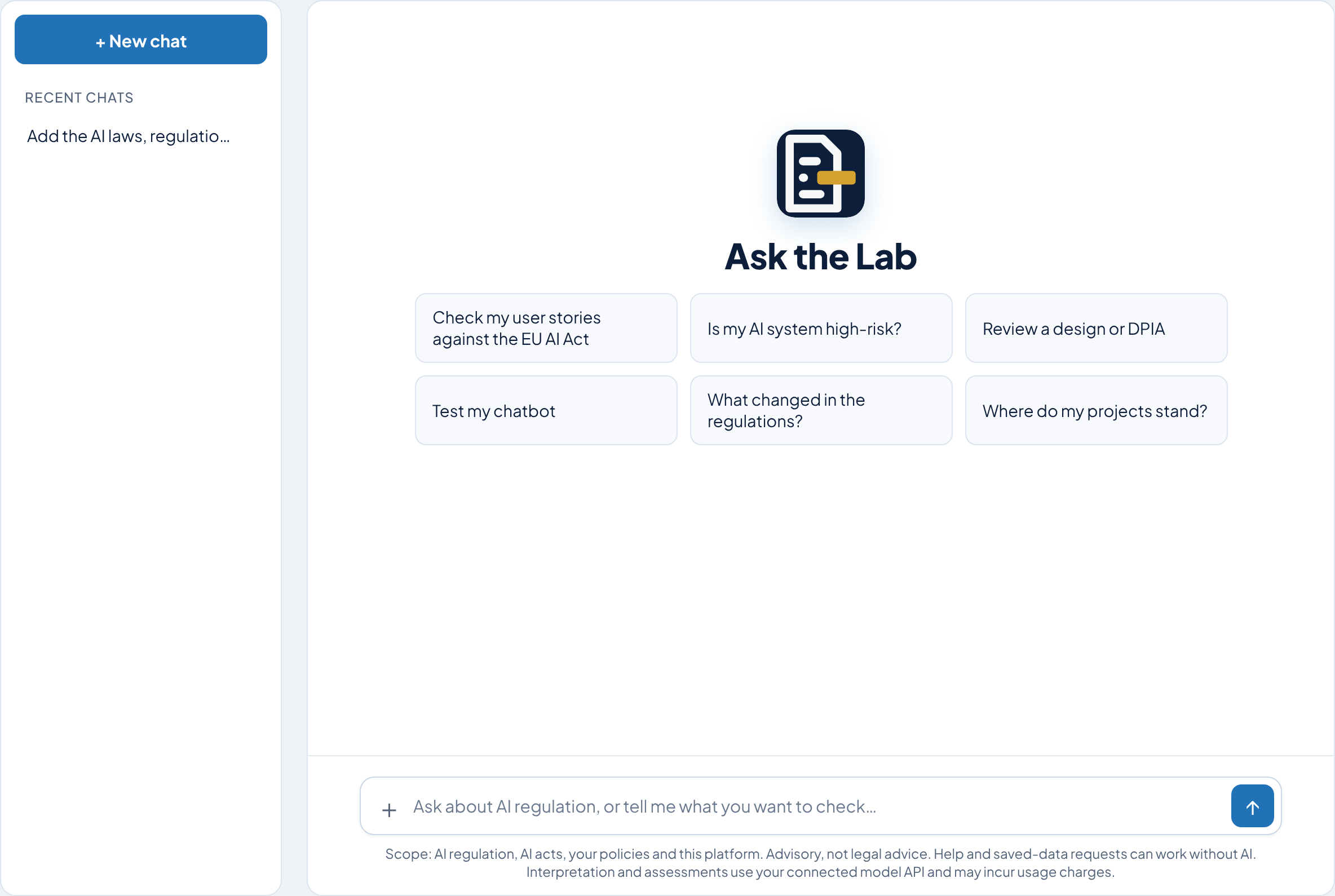
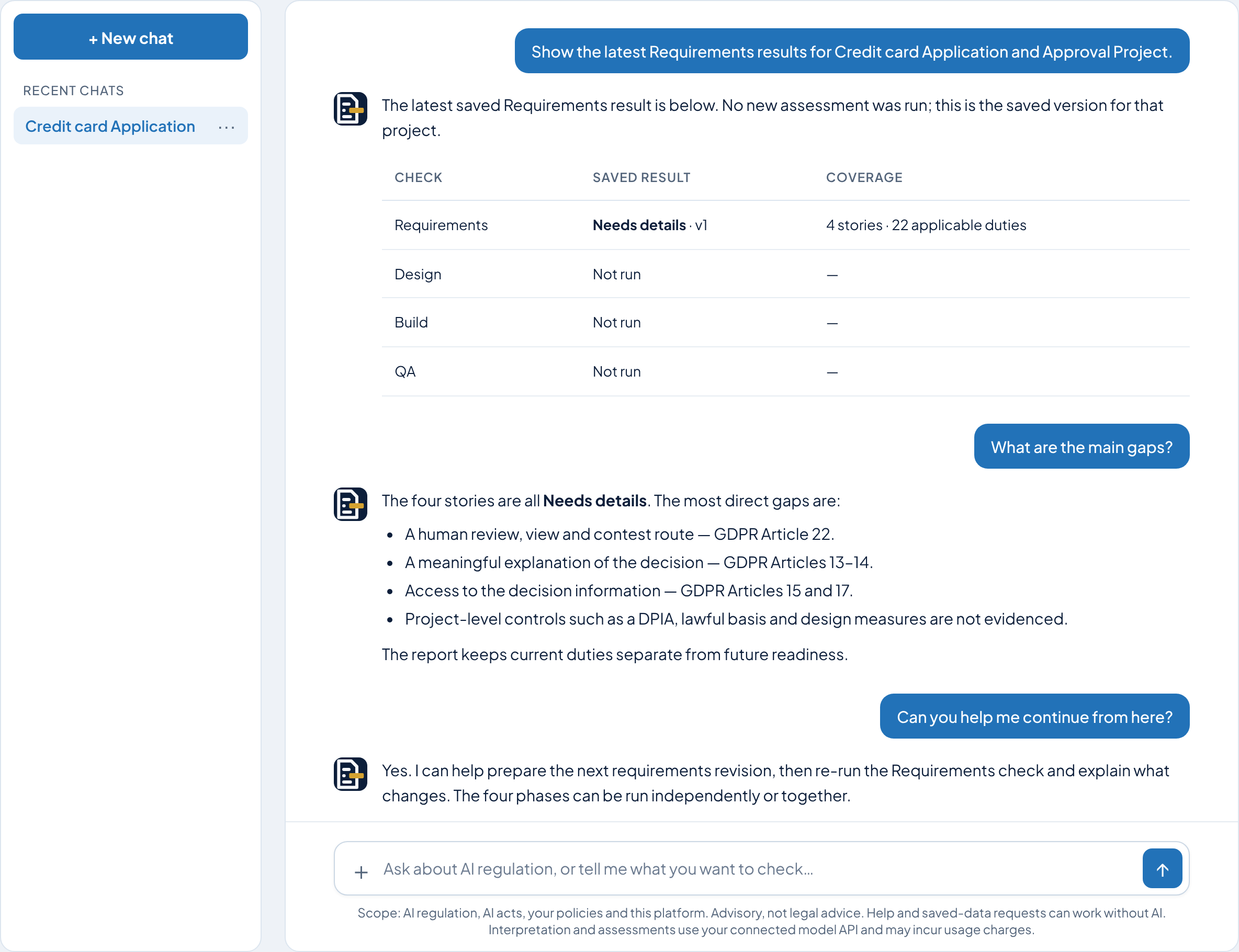
Anything DutAIx can do, you can ask for in conversation: create a project, add material, run the four checks, inspect saved results, compare versions and prepare the next action. Chat history keeps the work together, so you can return and continue where you left off.
Create and runInspect resultsCompare versionsChat history
The assistant follows the same review boundaries as the pages. Consequential actions still need the supported confirmation and human review.
SEE IT IN CONTEXT
Follow a finding.
Understand the decision.
Explore the platform using fictional project material in a practical walkthrough.
Request a walkthroughDutAIx provides assessment support, not legal advice or compliance certification. Results depend on configured coverage, project facts, supplied material and human review.